

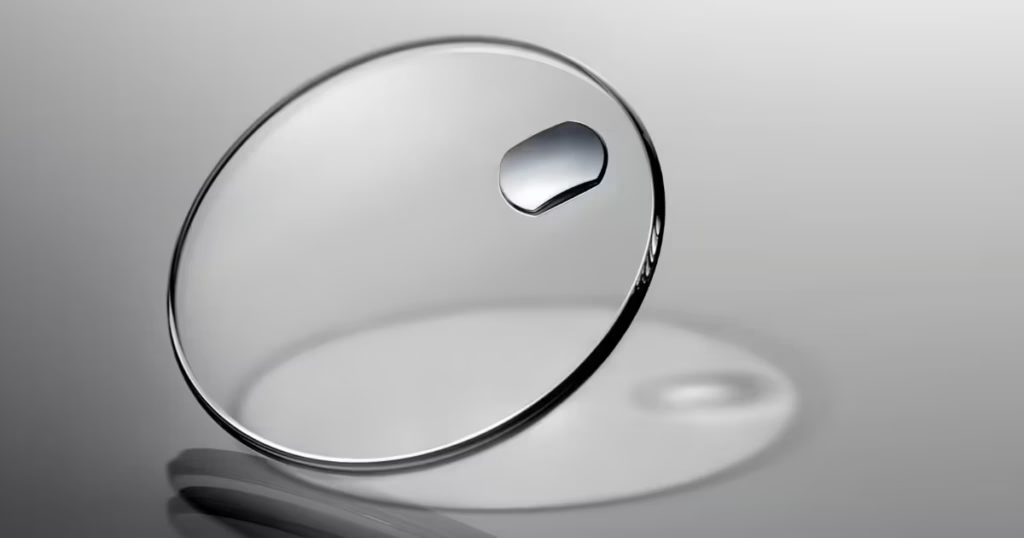
1. Debunking Myths
Sapphire isn’t stronger than mineral glass, mates. It’s scratch-resistant, but it actually handles direct impacts worse than mineral glass — precisely because of its hardness. I used to think that way too, a few years ago. And the idea that only a diamond can scratch sapphire is also a misconception, though you’re unlikely to encounter that — more on that later.
If you strike mineral glass hard, it will most likely just chip or crack, but it will remain in the case. If you strike sapphire glass with the same force (for example, with a sharp edge against a tile), it will shatter into tiny pieces, and these fragments could get inside the movement and kill the hands or calendar mechanism, or both.
As for acrylic, it goes by different names in stores: polymer, polyurethane — Casio even refers to it simply as “resin” — but in reality, it’s all plastic. Below, we’ll break down the pros and cons of each.
2. Sapphire
Let’s start with the most expensive. As for the blows, you get the idea: it’s incredibly hard, but pays for it with his fragility.
Just two minor issues:
- Glare: Due to its crystalline structure, sapphire is highly reflective. But! In high-quality watches, an anti-reflective coating is applied to the inner surface, ensuring that the dial is perfectly legible from any angle.
- Silicon carbide: It is found in some types of sandpaper, concrete, or brick dust. If you work on a construction site, I had to warn you.
That’s where the disadvantages of sapphire end. By nature, it is a synthetic crystal. On the Mohs hardness scale, it rates 9. The only material harder than sapphire is diamond (10).
This means you can wear the watch every day, let it rub against metal zippers, or accidentally bump it against keys in your pocket, and the glass will remain completely pristine. Even after 10 years of heavy use, the dial will look as if you’ve just taken the watch out of the box.
2. Mineral
Let’s get back down to earth. Mineral glass is the industry standard — a workhorse found in 80% of all modern watches (including the vast majority of G-Shock and Edifice models). Essentially, it’s ordinary silicate glass that has undergone a special thermal or chemical tempering process.
On the same hardness scale, it rates around 5–6. And here, its key strength lies in its perfect balance of properties.
- Impact Resistance: Mineral glass is more “flexible” than sapphire. When subjected to strong impacts, it will simply chip or crack, keeping the dial and movement safe. That is precisely why brands use it in tactical and sports watches.
- Scratches: It’s harder than you might think to accidentally scratch it with coins. But mineral glass has its Achilles’ heel—ordinary sand. Sand is harder (7 on the Mohs scale), so a single day at the beach or accidental contact with a dirty car hood can leave a noticeable scratch or groove on the glass.
Technically, you could polish it at a repair shop, but it’s such a hassle that in 99% of cases it’s easier and cheaper to just replace it — and thankfully, it doesn’t cost much.
So
It’s the perfect balance: it’s cheaper, it withstands impacts better, and if it gets scratched, it’s cheap and easy to replace.
3. Acrylic
Organic glass, polyurethane, Plexiglas, Hesalite, or Resin Glass (as specified by Casio). This is done for one reason — to avoid scaring off customers with the word “plastic.”
They say that if you stare at it long enough, you can scratch it — that’s absolutely true (not). Its hardness on the Mohs scale is a laughable 2–3. But why, then, is it used not only in $20 Casio watches, but also in expensive Swiss chronographs (like the Omega Speedmaster), which have even flown to the moon?
Answer:
- Durability: It’s the undisputed champion of durability. Acrylic is virtually unbreakable. Even under the most severe impact or pressure, it bends and flexes; it may develop a deep dent, but it will never shatter into pieces. For astronauts, divers, and athletes, this is critically important.
- Weight: It is significantly lighter than any glass
- Price: It is significantly cheaper than any glass
The Magic of Polishing
Unlike mineral glass, acrylic can be polished at home in just five minutes. A drop of special polish (or even regular toothpaste), a soft cloth, and a couple of minutes of rubbing — and the glass is perfectly smooth again, just like new.
So
Don’t be afraid of plastic if you’re getting a lightweight sports watch or a vintage classic. Scratches won’t bother you — you can fix them yourself, and you’d have to try really hard to break these watches.
Total
Don’t go for sapphire just because it’s “the most expensive and the coolest.” Don’t be afraid of plastic — it’s easy to polish. Choose a material that perfectly suits the lifestyle and habits for which the watch is intended.
The golden rule: there’s no such thing as perfect, shatterproof, scratch-resistant glass. There is glass designed to meet specific needs. Choose wisely