

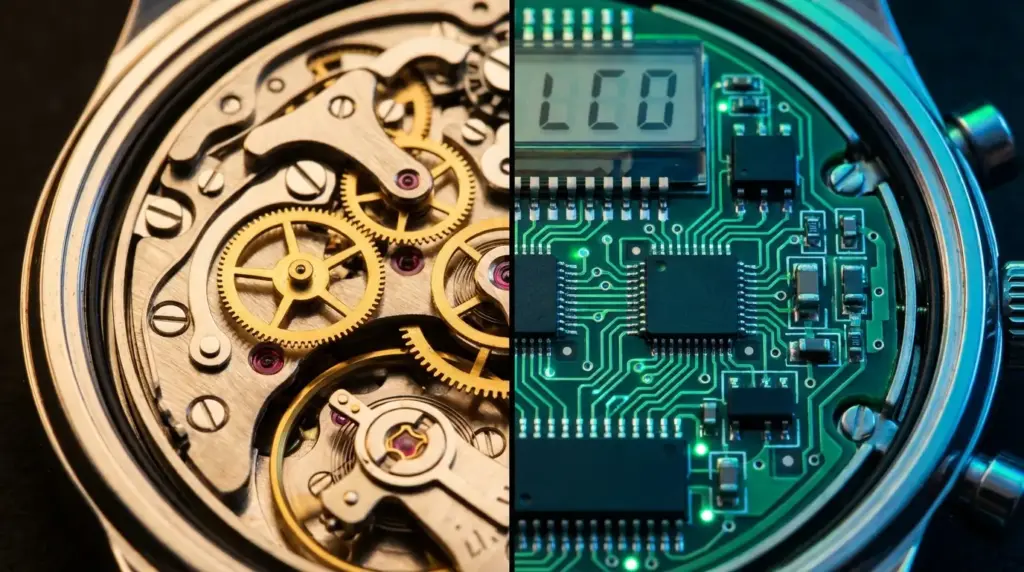
On any watch forum, you’ll always see this debate: some people say, “The shock-resistant movement is inside the case,” while others correct them, saying, “Actually, it’s a module.”
Let me put it this way — a module and a mechanism are two completely different things. It just so happens that we’ve gotten used to the word “movement” But a movement moves the hands, while a module changes the numbers on the display.
Хотя, сами Casio почему-то вообще Although, for some reason, Casio itself never uses the word “movement” — to them, everything is a “module”; this is the mass market, and they have their own strict nomenclature.
And their movements are actually pretty good. They’re designed in Japan — it may be by Casio itself, or may be by Miyota (which is part of Citizen) — but in most cases, everything is assembled in China anyway, whether it’s the modules or the movements.
That’s why all Casio watches have a module number stamped inside a rectangular frame on the back cover. This number is your watch’s “ID” — it’s what you use to look up instructions for all its functions. Well, for analog models with hands, you’ll find just a single paragraph explaining how to pull out the crown.
In short, here are the facts what’s what.
About Quartz
So, in the world of Casio, in the beginning was the word, and the word was “quartz.”
The magic always begins the same way: a battery supplies current, a quartz crystal begins to vibrate, and a circuit board detects these vibrations and measures out exactly one second. But from there, the paths diverge: this energy is directed either to the mechanism or to the module.
Movement
I think the movemtne is clear by now — it’s just gears, wheels, springs, and so on.
It’s also called a Caliber if someone wants to show off their horological expertise. But that doesn’t really apply to Casio. Call their bunch of screws a ‘Caliber,’ and you’re going to get some funny looks. Besides, unless you actually work for Casio, you’ll probably never know exactly what movements are inside anyway.
Module
The most interesting part.
The Casio module is essentially a computer, and it is responsible for the functionality of the digital models.
It is a complete circuit board with a processor, memory chip, quartz resonator, sensors, and display connectors soldered onto it.
If the watch has a dual display (digital screen + hands, like the CasiOAK), the module becomes even smarter — it controls both the screen and the independent motors for the hands simultaneously.
There are even models with two batteries that house both a movement — strictly for the hands — and a module at the same time. There are plenty of quirks with those, but in this article, we’re sticking to the basics.
Thank you for your attention