

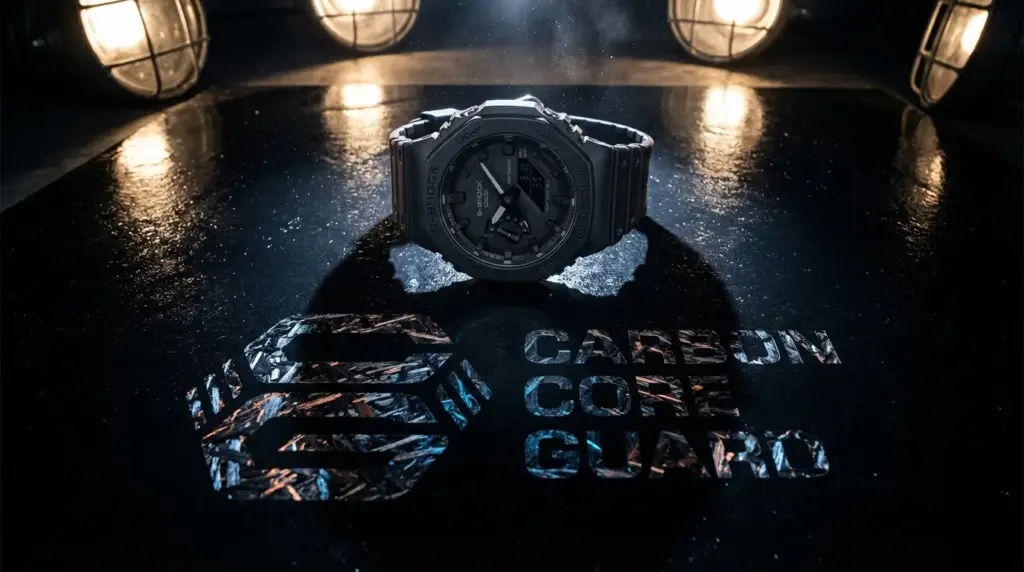
On the boxes and straps of modern G-Shock watches, you’ll increasingly see the bold inscription “Carbon Core Guard”. Casio presents this as though the watches are now forged from a single piece of carbon fiber taken straight from a Formula 1 race car.
The Carbon Illusion
My mind conjures images of interwoven layers of Kevlar, reminiscent of sports car interiors. But the Carbon Core Guard (with the exception of premium limited editions) is not made of pure carbon fiber.
In fact, it’s a special type of polyurethane (resin — the very same Casio Resin) that is generously reinforced with finely chopped carbon fiber during the molding process. The result is a composite plastic. It’s actually stiffer and stronger than older models, but it’s still a molded polymer.
This naturally raises a logical question: why was there any need to reinforce them in the first place? Did the old plastic “Shock” models from the ’90s break when they hit the wall? No, they were already indestructible; there was nothing to improve in terms of durability.
Dimensions
- The Battle of the Bulge. The addition of carbon fiber makes the material much stiffer. The case walls have become thinner. Thanks to Carbon Core Guard, the famous “CasiOak” (GA-2100) was born — the thinnest G-Shock in the brand’s history (only 11.8 mm thick). Previously, such elegance in the shock-resistant line was nothing more than a dream.
- The Downfall of Oversized Bumpers. Remember the old G-Shocks, where the buttons were deeply recessed into massive plastic protrusions on the case? This was done to ensure that, in the event of a fall, the impact wouldn’t be absorbed by the button stem. The carbon monocoque is so rigid that it maintains its shape perfectly on its own. There’s no longer a need for those massive protective bezels around the buttons, so the design has become cleaner.
- Extreme Diet. Carbon composite is lighter than standard polyurethane, let alone steel. You can barely feel the watch on your wrist.
How it works on the inside
In most models, the design consists of several components:
- Internal monocoque: that carbon-polyurethane capsule (often visible when viewed from the side) that securely houses the electronic module.
- Dual back cover: To make the case thinner, Casio redesigned the back. It now features a sealed steel plate covered by a fiberglass-reinforced polymer cover that protects the metal from direct impacts.
- Interchangeable bezel: The outer polyurethane ring no longer serves a rigid protective function; it has become a purely decorative element that can be easily replaced by unscrewing a couple of screws (in older models, the bezel had to be pulled on tightly, like a tire onto a rim).
So, Is it worth the cost?
Definitely yes. But you shouldn’t buy a watch with Carbon Core Guard just for its mythical “bulletproof” properties.
If you want the classic reliability of a G-Shock but have always been annoyed by their bulky size — which catches on your jacket sleeve or backpack—the new carbon models are just what you need. This isn’t just a marketing gimmick; it’s real technology that has made the rugged “Shocks” elegant and comfortable for everyday wear.