

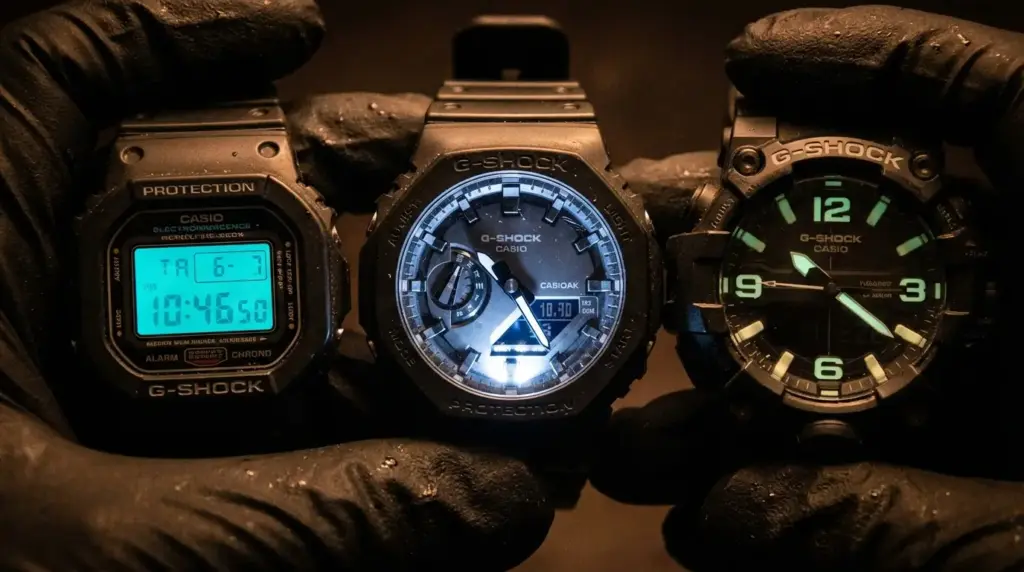
In short:
Like all big companies, Casio loves to come up with loud, beautiful names for simple things.
Illuminator: It was (originally) an electroluminescent backlight for the entire display—the very same blue one. On the Japanese market, it was called “Fox Fire.” and that’s where Casio turned its fans.
Super Illuminator: This is Casio’s marketing term for modern, ultra-bright LEDs (High-Brightness LED). We’ll take a closer look below.
Neobrite: a simple luminescent paint (usually strontium aluminate-based), like phosphorus. Its advantage is that it doesn’t drain batteries; its disadvantage is that it only stays bright for 15-30 minutes. However, after a while, your eyes adjust, and you’ll even see a dim glow.
1. Illuminator
Today, the word “Illuminator” has no technical significance whatsoever. Casio’s marketers have turned it into a generic brand. This name can conceal anything from a cheap LED with a piece of plastic (the diffusing plate), to a complex system of dual diodes, to that iconic neon panel from the 90s.
2. Super Illuminator
For many years, LED backlighting in watches was a source of jokes. A tiny bulb on the side illuminated exactly half the screen, leaving the other half in the dark. Casio realized it wasn’t very useful and rolled out the Super Illuminator.
In digital models, a powerful LED shines through a light-diffusing plate, illuminating the screen more or less evenly. In models with hands (and dual displays), a Double LED system is often used: one LED illuminates the analog dial, while the second independently lights up the digital displays.
There is no exact date in Casio’s official records marking the moment they cut the ribbon and announced, “Here’s the Super Illuminator,” as it was more of a gradual technological transition than a one-time launch.
One of the most famous early watches with this technology was the Casio MDV-102 analog diver (the ancestor of the famous Casio Duro “Marlin”). It featured two ultra-bright white LEDs that flashed so brightly that they could actually illuminate the road.
In the 2010s, Super Illuminator became the industry standard. The cost of manufacturing white SMD LEDs dropped, they became microscopic, and began consuming next to nothing in terms of energy. Around this time, Casio began incorporating Super Illuminator into nearly all of its analog Edifice, Pro Trek, and new-generation G-Shock models.
Now this watch simply says “ILLUMINATOR”
3. Electroluminescence
Casio is phasing out EL panels for four hard-nosed, pragmatic reasons:
Lower assembly costs. LEDs are now mass-produced by the billions and cost just a fraction of a cent. Incorporating a diode and a piece of plastic diffuser is simply cheaper and easier for mass production than assembling a multi-layered “sandwich” consisting of a screen and an EL panel.
Thickness and unnecessary details (Inverter). The watch battery outputs 3 volts. But to fire up an EL panel, you need an AC voltage of about 100 volts. To achieve this, a special step-up transformer (inverter) must be soldered onto the circuit board. It takes up space. Switching to LEDs allows you to eliminate the inverter, make the circuit board thinner, and free up space for Bluetooth modules or a pedometer.
Energy efficiency. The EL panel is a power guzzler. A watch with an EL panel lasts 2-3 years on a standard CR2016 battery. An LED (even a very bright one) consumes a tiny amount of power, and the same battery easily lasts the stated 5-10 years.
Material degradation. You can’t fool physics — the phosphor in an EL panel eventually burns out. After 7-10 years of active use, the panel begins to glow dimmer and may develop uneven patches. A modern LED is practically eternal; it will outlast the watch itself.
Although Casio continues to phase out this type of backlight, it can still be found in some models.
Untouchable Retro:
- The Casio A168 (and all its color variations, such as the A168WA). An absolute bestseller. The dial proudly bears the inscription “ElectroLuminescence.” If Casio were to remove the EL backlight from this model, it would be cause for a riot at their offices.
- Casio F-105W. This is the F-91W’s closest sibling. Externally, they are almost identical, but the F-105W is slightly thicker precisely because it features a full-fledged EL panel instead of a dim LED.
- Casio F-105W. This is the closest sibling to the F-91W. They are almost identical in appearance, but the F-105W is slightly thicker due to its use of a full-size EL panel instead of a half dead diode.
Remaining G-Shock stock (We are looking for models without the letter “U”)
- The DW-5600E (without the “U” at the end) is the classic basic “square” model. Its new version with a diode is called the DW-5600U.
- GW-M5610 (without U) is a top-of-the-line square with radio synchronization and Tough Solar.
- The DW-6900 (without the U) is the famous “three-eyed” G-Shock. The version with the LED was released quite recently, so there are still plenty of older models on the market.
- The DW-5900 and the massive King G-Shock GX-56. They were switched to LED backlighting right at the start of 2025 (the DW-5900U and GX-56UBB models), so the classic EL versions are still selling like hotcakes.
Premium Veterans (Master of G)
Some high-end professional “Shock” watches, whose modules were designed long ago and haven’t been updated since, still boast a cool EL display. The most striking example is the Frogman GWF-1000 digital diver’s watch. It features Full Auto EL Backlight technology (where the neon lights up automatically when you turn your wrist).
4. Neobrite
Here you get the idea, a classic light accumulator, no less.
Neobrite is simply the brand name for a luminescent paint. The Swiss call it Super-LumiNova, Seiko calls it LumiBrite, and Casio has named its compound Neobrite.
In ultra-budget models (the MTP, LTP, or MQ analog series), manufacturers cut every penny they can and use the cheapest luminescent paint (sometimes an older type based on zinc sulfide). You won’t find the word “Neobrite” in the specifications for these watches. It will simply say “Luminous Paint” or nothing at all. And this paint glows for maybe 5–10 minutes at most, after which it fades completely.
Custom: What Fans do with Backlighting
If you’re not satisfied with the stock lighting, welcome to the underground. The community has long since established a whole industry of DIY modifications. When a standard LED or inverted screen isn’t enough, hardcore customization comes into play:
- Colored filters (The most popular mod). It costs next to nothing but looks like a million bucks. Take the watch apart, remove the module, and place a thin colored film between the LCD screen and the backlight (even a piece from old 3D glasses or a theater light filter will work). As a result, the dull white LED starts glowing blood-red, toxic-green, or purple.
- Reversing the polarity (Screen inversion). Black “inverted” screens look cool, but they’re a nightmare to read. What do fans do? They take the watch apart, carefully peel the factory polarizing film off the screen with a blade, and stick on a new one, rotating it 90 degrees. Bingo—the unreadable black screen turns into a perfectly readable light one (or vice versa).
- Re-soldering SMD diodes (for the crazy ones). If you’re comfortable with micro-soldering, you can simply desolder the factory diode from the board and replace it with a new micro-LED in any color you like.
- Hydromod (Oil filling). The watch case is filled with silicone oil. This not only makes it virtually indestructible at any depth (the liquid is incompressible), but also radically changes the visual appearance. The backlight appears incredibly deep when viewed through the oil and is clearly visible from any angle, without glare from the glass.
An important point to note: Opening the case voids the warranty. One wrong move, and the module is headed for the trash. If you’re not willing to take that risk, it’s best to choose a watch that looks great right out of the box.